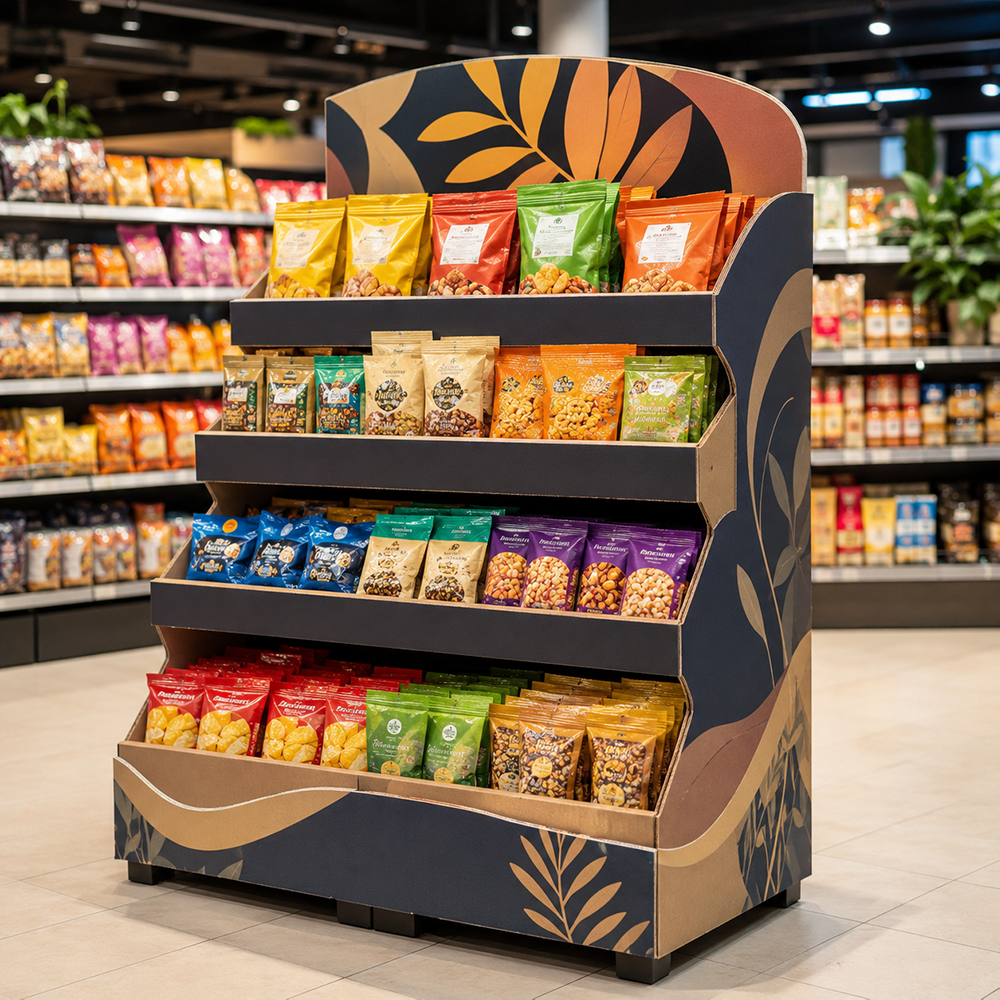
Why Global Retailers Are Switching to Recyclable Cardboard Displays
Cardboard POS displays are moving from a design choice to a compliance choice. By 2026, recyclability, fees, and store operations make corrugated a smart default.
Back to blogs
Retail display materials are no longer evaluated solely by visual appeal and unit cost. By around 2026, procurement teams must handle both the cost impacts of packaging waste regulations and extended producer responsibility (EPR) fees, while also meeting retailers' sustainability key performance indicators.
In this context, many retailers and brands will choose recyclable cardboard display stands, especially corrugated cardboard POS displays, as a strategic decision for risk management and total cost of ownership (TCO), rather than merely a design trend.
Importantly, this discussion focuses on cardboard display stands that travel through the retail supply chain with products (e.g., PDQs, display shippers, shelf-ready packaging) and are treated similarly to packaging in terms of compliance. These displays are typically shipped and assembled with the products and later enter the waste stream.
In most compliance frameworks, they cannot be treated as separate "props" but are assessed by packaging recyclability, material use, and disposal cost. (Fully standalone floor displays might be treated differently in some markets.)
Consequently, cardboard display stands are increasingly evaluated under packaging regulations.
Sustainable Packaging as a Retail Main KPI
Packaging accounts for a large share of material use and waste, making it central to retail sustainability strategies. Public data from the EU reveals the link between packaging, plastic use, and waste. For example, EU data shows that per-capita packaging waste is around 186.5 kg/year (36 kg of which is plastic packaging), with packaging materials accounting for about 40% of the EU's plastic consumption.
Globally, solid waste is projected to increase significantly. The United Nations Environment Programme (UNEP) forecasts that urban waste volumes will rise from about 2.1 billion tons in 2023 to 3.8 billion tons by 2050. These trends are driving retailers to incorporate packaging recyclability, material reduction, clear recycling instructions, and disposal costs into quantifiable key performance indicators for sustainability.
Meanwhile, in-store promotions remain crucial to retail sales despite the rapid growth of e-commerce. Industry research predicts that the global point-of-purchase (POP) display market will reach $17 to $18 billion by 2026, with corrugated cardboard continuing to account for a significant share. In other words, physical store displays remain key marketing touchpoints, particularly for launching new products and driving impulse purchases.
Opting for display stands made from recyclable cardboard naturally aligns with retailers' sustainability goals without undermining marketing effectiveness at the point of sale.
Regulation-Driven Materials Shift and Economics
New regulations are reshaping constraints, while cost mechanisms make material selection a compliance issue, accelerating the shift toward cardboard materials.
Extended Producer Responsibility (EPR) Costs
Material selection now directly affects ongoing costs. For example, the UK's updated Extended Producer Responsibility (EPR) system (phased in from April 2025) sets much higher disposal fees for plastics than for paper/cardboard.
The base rates for the 2025-2026 fiscal year are: GBP 423 per ton for plastics, GBP 196 per ton for paper/cardboard, and GBP 192 per ton for glass. Retailers using large plastic display stands will bear significantly higher compliance fees than those using cardboard display stands. In major economies, this cost gap has formed a strong economic incentive, prompting enterprises to shift to the use of wood-fiber materials.
Total Cost of Ownership (TCO)
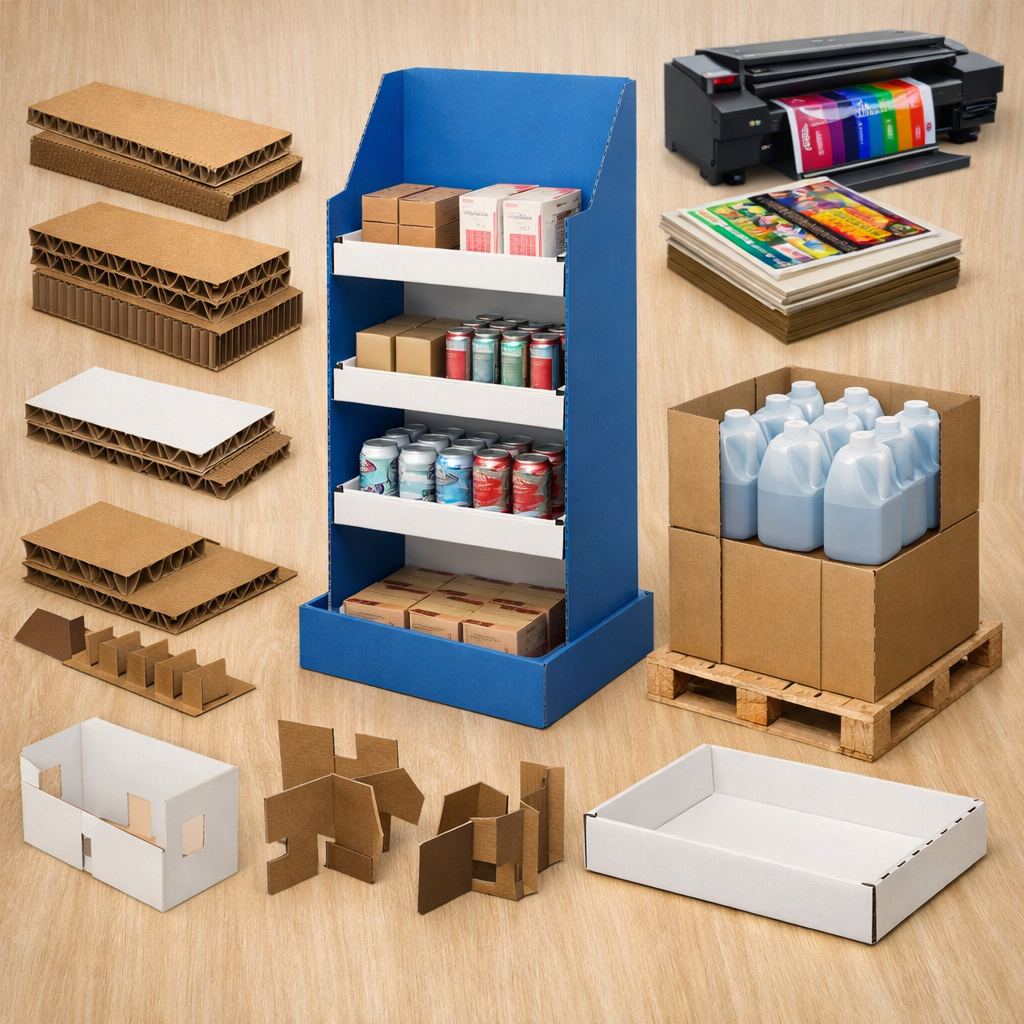
Beyond compliance fees, cardboard displays offer numerous operational advantages. Corrugated displays are foldable for shipping, assemble quickly on-site, and balance lightweight construction with high stability. For retailers with thousands of stores, flat-pack shipping reduces freight and warehouse costs, while rapid assembly saves labor. These factors are incorporated into total cost of ownership calculations. Industry analysis indicates that floor displays and corrugated cardboard solutions remain core elements of in-store merchandising. Their use of cost-effective, recyclable materials makes them suitable for national rollout.
Waste Management
Retailers focus on actual recyclability rates rather than theoretical recyclability. Stores require display stands that can be easily recycled within existing systems. Paper and cardboard are the most mature recyclable categories in many regions. For example, U.S. Environmental Protection Agency data shows that paper and cardboard recycling rates far exceed those of plastics. UNEP reporting commonly cited in industry discussions indicates that paper and cardboard recycling in the United States is far higher than plastics, and plastic film recycling is especially low.
Cardboard displays can typically be integrated into standard paper recycling streams, while plastic displays may be non-recyclable or difficult to collect. Consequently, cardboard displays can reduce the burden of waste management for stores.
Policy Timeline and Regulatory Comparison
In the EU, the Packaging and Packaging Waste Regulation (PPWR) is scheduled to apply from 12 Aug 2026, with 2030 as a key milestone for higher recyclability targets. The regulation emphasizes recyclable design and material reduction, which makes corrugated cardboard based display formats, especially PDQs and display shippers that move through the supply chain with products, a strong fit due to their single-material structure and recyclability profile.
In the UK, the Packaging EPR (pEPR) fee mechanism is being phased in starting in Apr 2025, and Year 1 base fees have already been published. Because paper and cardboard carry significantly lower fees than plastics and benefit from more mature recycling systems, switching to cardboard displays can reduce long-term compliance costs and related risks.
In the US, packaging EPR is advancing at the state level, and timelines differ by state. For example, Oregon's new program starts in July 2025, while California is expected to begin collecting fees in 2027 and set a requirement for packaging to be 100% recyclable or compostable by 2032. As multi-state compliance pushes producers to share recycling costs, standardizing on easily recycled cardboard materials often improves compliance execution and cost control across states.
These policies underscore a key point: the selection of packaging materials will directly affect compliance costs. By 2030, PPWR requirements aim for packaging (and associated display shipping formats) to meet recyclability expectations. In the UK, published disposal fees highlight the cost advantage of paper packaging. In the US, manufacturers in states like California will face significant fees unless packaging is recoverable. Retailers need to adjust their display materials accordingly.
Consumer Preference and Brand Image
The material of a display conveys brand values to consumers. Surveys reveal a clear consumer preference for recyclable packaging. For example, Pro Carton research reports that many consumers choose cartonboard packaging over plastic packaging for the same products, and a majority consider "easy to recycle" a key packaging attribute. A significant share of consumers also report switching brands when competitors offer more sustainable packaging.
In the U.S., Shorr Packaging research reports that most consumers prefer brands using sustainable packaging, and many have switched brands due to competitors offering more sustainable packaging. Many consumers are also willing to pay a premium for greener packaging.
These trends show that using recyclable display materials is not just about compliance, it is about maintaining consumer trust. If a store's displays are not recyclable yet the brand markets itself as "green", customers may become skeptical and distance themselves. Research commonly finds that when consumers doubt a brand's environmental claims, purchase intent drops sharply. In contrast, brands that use recyclable materials and clearly communicate disposal guidance can earn loyalty and reputation benefits.
Technology and Supply Chain Considerations
Implementing recyclable cardboard display stands requires comprehensive design and supply chain coordination.
- Matching strength: Select appropriate corrugated profiles and flute layers (single-wall, double-wall, etc.) to support lightweight and heavy products. Avoid the misconception that "thicker is better". Require suppliers to validate load-bearing capacity.
- Single-material design: Avoid composite laminations or non-paper attachments. If plastic components (e.g., clear panels, sleeves) are necessary, prioritize removable clips or buckles. Minimizing mixed materials improves recyclability.
- Eco-friendly inks and adhesives: Use water-based or soy-based inks and non-toxic adhesives. These options simplify recycling and reprocessing. Secure ink/adhesive specifications in procurement documents for large projects to prevent regional deviations.
- Standardization and modularity: Prioritize modular display platforms. Standardized dielines and replaceable graphics reduce the need for custom molds for each event, accelerating deployment. Suppliers with pre-engineered, widely validated designs enable rapid global rollouts.
- Chain of custody: If procurement policies require forest certification (e.g., FSC, PEFC), ensure suppliers provide certification or chain-of-custody documents for cardboard. Even if displays lack certification labels, ready documentation meets audit requirements and strengthens sustainability claims.
By integrating recyclability criteria into design, engineering, and procurement, retailers ensure displays are truly recyclable in practice, not just in theory.
Conclusion and Recommendations
Conclusion
By around 2026, driven by regulatory compliance requirements and commercial rationale, recyclable cardboard display stands will gradually become widespread. Display materials should be regarded as a critical component of the packaging supply chain. Procurement decisions need to shift from focusing solely on unit cost to evaluating the total sustainable cost of ownership, including extended producer responsibility fees, logistics, labor, and disposal costs.
Recommendations for Procurement Teams
- Define clear recyclability targets: Set recyclability and material standards for displays (especially those shipped with products, e.g., PDQs) by regions and product lines to ensure compliance with local packaging regulations.
- Quantify total costs: Incorporate EPR fees, logistics and warehousing costs, in-store labor, and waste disposal into TCO models. For example, compare material options based on UK EPR rates (plastic GBP 423 vs paper GBP 196).
- Align with brand and retail strategy: Use genuinely recyclable materials and add clear recycling instructions (e.g., printed disposal labels) to displays. This helps avoid greenwashing concerns and builds brand integrity.
- Collaborate with experienced suppliers: Select providers capable of offering standardized corrugated solutions, supporting cross-regional expansion, and providing material certification documents. Fast global fulfillment shortens lead times, while proven designs ensure reliability.
By following these steps, retailers and brands can reduce compliance risks, cut operational costs, satisfy consumer demand for sustainability, and maintain effective in-store merchandising.
References
- European Commission, "Packaging and Packaging Waste" (PPWR) regulation summary.
- UK Government, "Extended Producer Responsibility for Packaging (EPR), Base Fees 2025."
- Oregon Department of Environmental Quality, "Recycling Modernization Act (House Bill 2021)."
- California Department of Resources Recycling and Recovery, "SB 54 Packaging Recycling Regulations."
- UNEP, "Waste Pollution 101" (global waste projections).
- Mordor Intelligence, "Global POP Display Market" (projection for 2026).
- Pro Carton, "European Consumer Packaging Perceptions Study 2025."
- Shorr Packaging, "2025 Sustainable Packaging Consumer Report."
Recyclable corrugated cardboard POS displays, shipped with products and built for fast in-store setup, help brands cut compliance risk and total cost of ownership by 2026.
Useful Links:
Latest Posts
All Posts