How Corrugated POP Displays Are Tested for Load Capacity
Learn how corrugated POP displays are tested for load capacity, shipment durability, and structural reliability before retail rollout.
Back to blogs
Executive Summary
Load-bearing testing helps verify whether corrugated cardboard POP displays can safely support the weight of products and remain stable during shipping, handling, and in-store setup. Because performance will be affected by board grade, assembly quality, humidity, and load distribution, effective testing goes beyond simple load-bearing checks. A reliable testing program typically combines static load-bearing, transportation simulations, environmental adaptability, and clearly defined pass-or-fail criteria.
Introduction
Corrugated POP displays are widely used because they are lightweight, cost-effective, and easy to deploy. Even so, their structural performance still needs to be validated under real-world conditions. A display that appears sturdy at first glance may perform inconsistently if there are changes in materials, assembly quality, or load patterns.
That is why load capacity testing should evaluate more than a theoretical weight limit. It should also confirm whether a display remains stable, functional, and retail-ready after shipping, handling, and store setup. For brands and retailers, this helps reduce rollout risk and supports more reliable in-store execution.
Industry Standard Test Methods for Corrugated POP Displays
Several testing methods are commonly used to evaluate the load-bearing performance of corrugated cardboard POP displays.
Static load testing is used to evaluate the performance of shelves, pallets, and base structures under sustained loads. Under standard and extreme conditions (such as uneven loads or front-heavy/rear-light loads) , calibrated weights or real products can be used to apply loads to the display. This helps uncover issues such as sagging, creeping, seam separation, or the risk of tipping over time.
Compression and stacking tests are used to measure vertical strength. These tests are commonly used in corrugated packaging evaluations and help define the ability of key components or fully assembled units to resist top-down pressure during warehousing, shipping, and stacking.
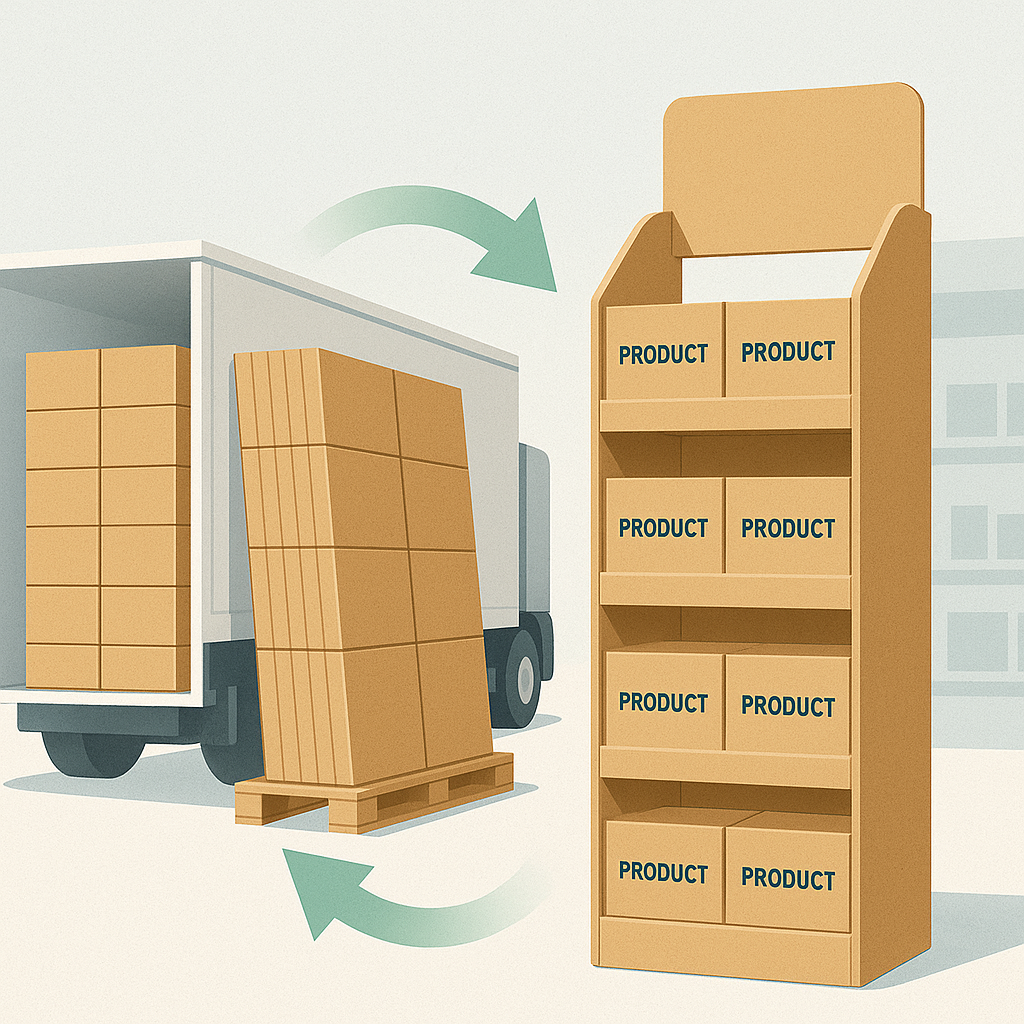
Transportation simulation is also a critical part of this process. Displays may perform well under controlled indoor conditions but may lose strength after undergoing vibration, drops, or impacts during shipping. Therefore, many test programs conduct transportation simulations before conducting repeated load checks on unpacked displays.
Environmental conditioning is necessary because corrugated cardboard is highly sensitive to moisture and humidity. Environmental changes can reduce structural strength; thus, testing should be conducted under controlled and recorded temperature and humidity conditions to enhance consistency and repeatability.
Performance Metrics and Pass-or-Fail Criteria
Load-bearing capacity cannot be assessed by weight alone. Key evaluation criteria usually include the rated working load, maximum load before failure, allowable deflection under rated load, permanent deformation after unloading, and the type and location of structural failure.
In practical application, a display is deemed compliant when it remains stable, functional, and within specified deformation limits under defined test conditions. Even if a display is technically capable of bearing the load, it may still be deemed non-compliant in a real retail environment if it suffers deformation, tilting, or becomes difficult to handle.
How We Test Load Capacity at Meiya Stand
At Meiya stands, load-bearing tests are integrated into our broader quality control process.
We begin with supplier qualification reviews and incoming inspections to verify board grade, moisture content, and production consistency before manufacturing begins. During assembly, we also inspect bonding, assembly, and alignment to reduce deviations before formal testing begins.
During the validation period, we test multiple devices from actual production batches rather than relying on design-stage samples alone. After environmental conditioning, each display is assembled according to approved operational guidelines and tested under controlled load conditions step-by-step. During testing, we record load levels, dwell times, deflection, and any visible structural changes.
We also evaluate the durability of products post-shipment through transportation-related tests as required by the project. Depending on the products, shipping methods, and customer requirements, testing may include compression, vibration, and drop tests. After unpacking and reassembling the displays, we retest them to compare performance before and after shipment and identify any decline in structural reliability.
We record environmental conditions, setup details, visual observations, photographs, and failure points throughout the process. Test results are subsequently reviewed against agreed-upon standards, functional requirements, and safety margins.
Testing Considerations
Test methods and acceptance criteria can vary depending on the product category, shipping route, retail environment, and customer expectations. Safety margins, dwell time, loading patterns, and visual standards should all be defined in advance.
It is also important to distinguish structural failure from minor cosmetic issues. In some projects, appearance is part of the approval criteria. In other cases, the priority lies on ensuring the displays remain safe, stable, and functional throughout their entire expected retail cycle.
Conclusion
Load capacity for corrugated POP displays is about more than a theoretical weight limit. A well-tested display should remain stable, functional, and retail-ready through shipping, setup, and in-store use.
For brands and retailers, a structural testing process helps reduce launch risk, improve in-store reliability, and support smoother point-of-purchase execution. At Meiya Stand, load testing helps ensure displays not only look perfect but also perform reliably in actual retail environments.

Corrugated POP display undergoing load capacity testing in a controlled quality inspection environment.
Useful Links:
1. Structural Design of Corrugated POP Displays: Premium Appearance, Solid Strength
https://meiyastand.com/post/structural-design-of-corrugated-pop-displays-premium-appearance-solid-strength
2. Flat-Pack Shipping for POP Displays: How to Reduce Damage and Lower Freight Costs
https://meiyastand.com/post/flat-pack-shipping-for-pop-displays-how-to-reduce-damage-and-lower-freight-costs
3. Corrugated POP Displays: A Practical Pre-Shipment Inspection Checklist
https://meiyastand.com/post/corrugated-pop-displays-a-practical-pre-shipment-inspection-checklist
4. Cardboard POP Displays: A Practical Guide to Printing and Materials
https://meiyastand.com/post/cardboard-pop-displays-a-practical-guide-to-printing-and-materials
5. Tool-Free POP Display Assembly: How Brands Can Speed Up In-Store Setup
https://meiyastand.com/post/tool-free-pop-display-assembly-how-brands-can-speed-up-in-store-setup